For skilled professionals who want a U.S. green card without depending on an employer, the EB-2 National Interest Waiver (NIW) is one of the most attractive options. It lets you skip both the job offer and the PERM labor certification process, and you can file the petition yourself.
That flexibility comes with a demanding standard. Understanding the EB-2 NIW requirements, especially the three-prong Dhanasar test, is the key to building a petition that holds up under USCIS review.
Key Takeaways
In this article, you will learn:
What the EB-2 NIW is and why it appeals to professionals
The basic EB-2 eligibility you must prove first
How each prong of the Dhanasar test works
How to define a strong proposed endeavor
How the NIW self petition process works
Common mistakes that lead to denials
What Is the EB-2 National Interest Waiver?
The EB-2 category is for professionals with advanced degrees or exceptional ability. Normally, an EB-2 applicant needs a U.S. employer to sponsor them and complete labor certification, which proves no qualified U.S. worker is available for the job.
The national interest waiver removes that requirement. If you can show that your work benefits the United States enough, USCIS can waive the job offer and labor certification entirely. This makes the NIW popular with researchers, engineers, doctors, entrepreneurs, and other specialists.
What Are the Basic EB-2 NIW Requirements?
Before USCIS looks at the national interest question, you must first qualify for the EB-2 category itself. Under USCIS guidance updated in January 2025, this is treated as a threshold issue, so a weak showing here can end the case early.
Advanced Degree Professional
You qualify through an advanced degree if you hold:
A U.S. master's degree or higher, or a foreign equivalent, or
A U.S. bachelor's degree or foreign equivalent plus at least five years of progressive post-degree experience in the field
The work you plan to do in the U.S. must also count as a “profession,” meaning an occupation that requires at least a U.S. bachelor’s degree or its foreign equivalent just to enter the field. It should also connect to the degree you hold.
Person of Exceptional Ability
Alternatively, you can show exceptional ability in the sciences, arts, or business by meeting at least three of six criteria. These include a relevant degree, at least ten years of full-time experience, a professional license, a high salary, membership in professional associations, and recognition for significant contributions.
What Is the Dhanasar Test?
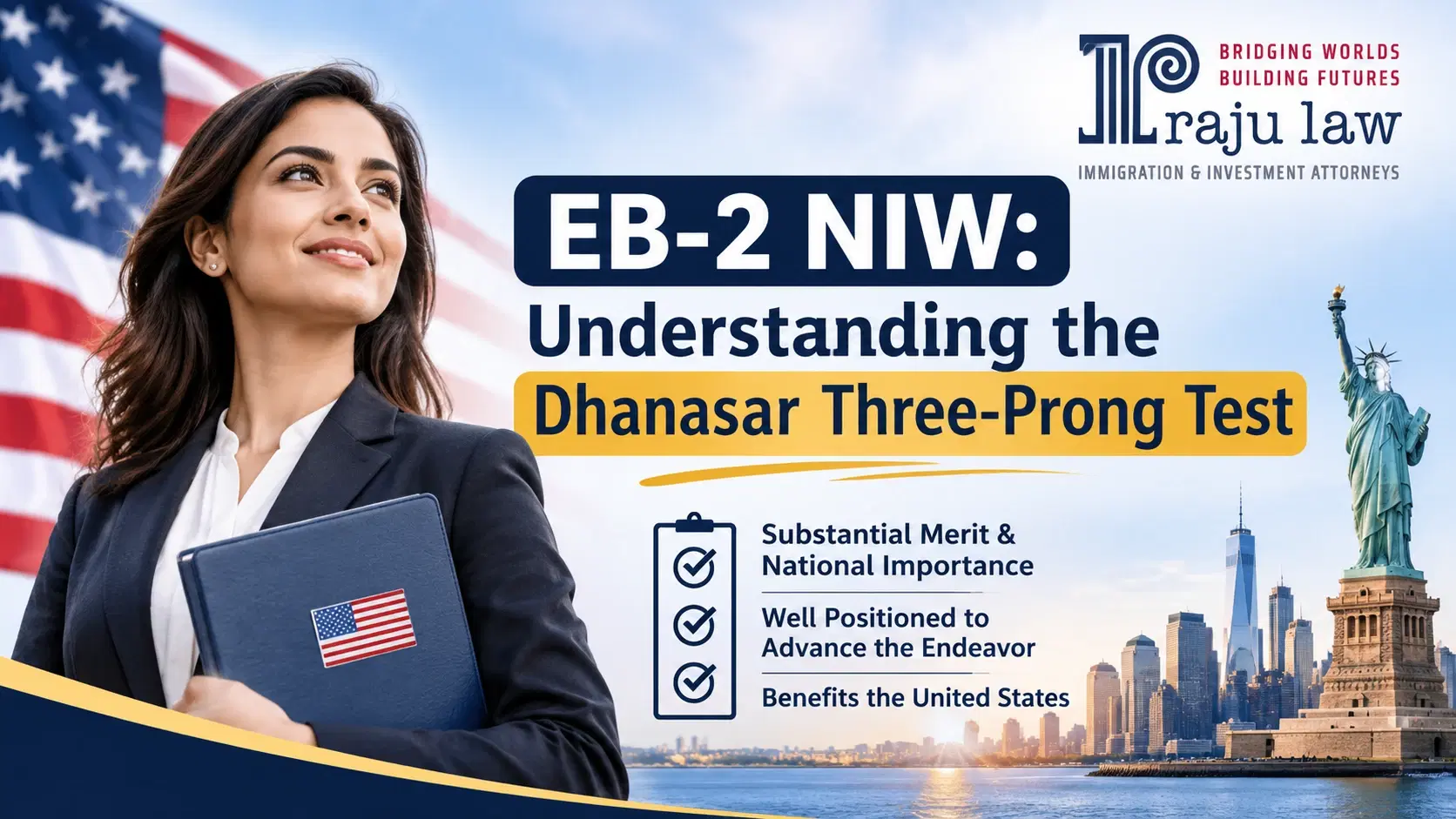
Once EB-2 eligibility is established, USCIS applies the Dhanasar test, set out in the 2016 precedent decision Matter of Dhanasar. National interest waiver eligibility depends on proving all three prongs.
Prong 1: Substantial Merit and National Importance
Your proposed endeavor must have substantial merit and national importance. Merit can come from many areas, such as business, health, science, technology, education, or culture.
National importance is about the wider impact of the work, not the importance of your field in general.
Prong 2: Well Positioned to Advance the Proposed Endeavor
The second prong focuses on you. USCIS considers factors such as:
Your education, skills, and knowledge
Your record of success in similar efforts
A model or plan for future work
Progress you have already made
Interest from potential customers, users, investors, or other relevant parties
You do not need to prove your endeavor will definitely succeed, but you must show you are realistically capable of moving it forward.
Prong 3: On Balance, the Waiver Benefits the United States
Finally, you must show that, on balance, waiving the job offer and labor certification benefits the U.S. USCIS may consider whether labor certification would be impractical for your type of work, whether the U.S. gains even if qualified U.S. workers are available, and whether your contributions are urgent.
How Do You Define a Strong Proposed Endeavor?
The proposed endeavor is the specific work you plan to do in the U.S., and it is the foundation of the entire Dhanasar test. A vague goal like "continue working in data science" rarely succeeds.
A strong endeavor statement should:
Describe exactly what you will do and where
Explain who benefits and how
Connect directly to your past experience and achievements
Show impact beyond a single employer or client, backed by independent assessments of your accomplishments, such as letters from experts you have not worked with, citations of your work, or coverage in industry media
Supporting evidence, such as a business plan, expert letters, or published research, should all point back to this one clearly defined endeavor.
How Does the NIW Self Petition Process Work?
The NIW self petition is one of the category's biggest advantages. You can file Form I-140 on your own behalf, without an employer, and you are free to change jobs as long as you continue working in the area of your proposed endeavor.
The general process looks like this:
File Form I-140. If you want a faster answer, you can request premium processing with Form I-907. The fee is currently $2,965, and for NIW petitions USCIS commits to acting on the case within 45 business days. That action may be an approval, a denial, or a request for evidence. Premium processing speeds up the I-140 decision only. It does not shorten the wait for a visa number.
Wait for your priority date. At the time of writing, the Visa Bulletin shows a cutoff date for EB-2 applicants from every country, so all NIW applicants should expect some wait before they can move to the green card stage. Applicants born in heavily backlogged countries, such as India and China, face much longer waits. Check the current Visa Bulletin before planning your timeline, since the dates change monthly.
For budgeting, the government fees for an NIW self-petition total $1,015, made up of the $715 Form I-140 filing fee and a $300 Asylum Program Fee. Physicians should also know they have a separate NIW route that does not use the Dhanasar test, available to doctors who commit to five years of full-time clinical work in a designated shortage area or at a VA facility.
Because USCIS has been scrutinizing NIW petitions more closely, a complete and well-organized initial filing matters more than ever. Our article on the January 2025 USCIS NIW policy update explains what changed.
What Are Common Reasons for NIW Denials?
Many petitions fail for avoidable reasons:
Weak EB-2 eligibility. Missing degree evaluations or experience letters.
A vague proposed endeavor. Broad goals with no clear plan.
Confusing field importance with national importance. Your field may matter, but you must show your specific work does.
Generic recommendation letters. Letters should explain your actual contributions in concrete terms.
Little proof of progress. Plans without results make Prong 2 hard to meet.
An experienced immigration attorney can spot these gaps before you file.
Ready to File Your EB-2 NIW Petition?
The EB-2 NIW offers independence and a path to permanent residence, but meeting the EB-2 NIW requirements takes a focused strategy and strong evidence for every prong of the Dhanasar test.
At Raju Law, we help professionals define their proposed endeavor, organize their evidence, and present a clear case to USCIS. Request a consultation today to find out whether you qualify.