
If your research or teaching has earned recognition beyond your own campus or lab, the EB-1B visa may be one of the fastest routes to a U.S. green card. But the EB-1B requirements are specific, and USCIS expects detailed proof. This guide explains who qualifies, what evidence works, and how to build a strong case.
Key Takeaways
In this article, you will learn:
What the EB-1B visa is and who it is for
The three core EB-1B requirements every applicant must meet
The six EB-1B criteria and how USCIS reviews them
How EB-1B employer sponsorship works
The main differences in EB-1B vs EB-1A
Practical ways to strengthen your petition
What Is the EB-1B Outstanding Researcher Visa?
The EB-1B is an employment-based immigrant visa, often called the outstanding professor or researcher green card. It is part of the EB-1 first preference category, alongside EB-1A (extraordinary ability) and EB-1C (multinational managers and executives).
The biggest advantage is that EB-1B does not require PERM labor certification. Your employer does not have to test the U.S. labor market or prove that no qualified U.S. worker is available, which removes an entire Department of Labor stage from the process.
The category is open to all academic fields, including the sciences, engineering, medicine, the humanities, social sciences, and business research. A Ph.D. is common among applicants, but the law does not strictly require one.
What Are the Core EB-1B Requirements?
Every applicant must meet three threshold requirements. Missing any one of them will sink the petition, no matter how strong the rest of the file is.
1. International Recognition in a Specific Academic Field
You must be recognized internationally as outstanding in a specific academic field. The field should be defined with care: "particle physics" works better than "physics," but it should not be so narrow that it covers only your dissertation topic.
Recognition must reach beyond your own institution and home country. Praise from your supervisor or colleagues is helpful, but on its own it is rarely enough.
2. At Least Three Years of Teaching or Research Experience
You need at least three years of teaching and/or research experience in your academic field, and you can combine the two. Experience gained while earning an advanced degree generally counts only if the degree was completed and the teaching involved full responsibility for the class, or the research itself was recognized as outstanding.
Document this with employer letters that show exact dates, job titles, and duties.
3. A Qualifying Permanent Job Offer
A U.S. employer must offer you one of the following:
A tenured or tenure-track teaching position at a university or institution of higher education
A comparable permanent research position at a university or institution of higher education. A grant-funded role renewed one year at a time is not automatically ruled out. USCIS guidance treats it as permanent when the employer shows it plans to keep pursuing funding for the role and has good reason to expect that funding to continue.
A permanent research position with a private employer. Under 8 CFR § 204.5(i)(3)(iii)(C), USCIS looks at the specific department, division, or institute making the offer, not just the company as a whole. That unit must have at least three full-time researchers on staff and a documented record of accomplishments in the academic field.
"Permanent" means a position of indefinite or unlimited duration with an expectation of continued employment. Temporary postdoctoral roles usually do not qualify. The offer letter must also be addressed to you; a letter to USCIS that simply describes the job is not enough.
What Are the Six EB-1B Criteria?
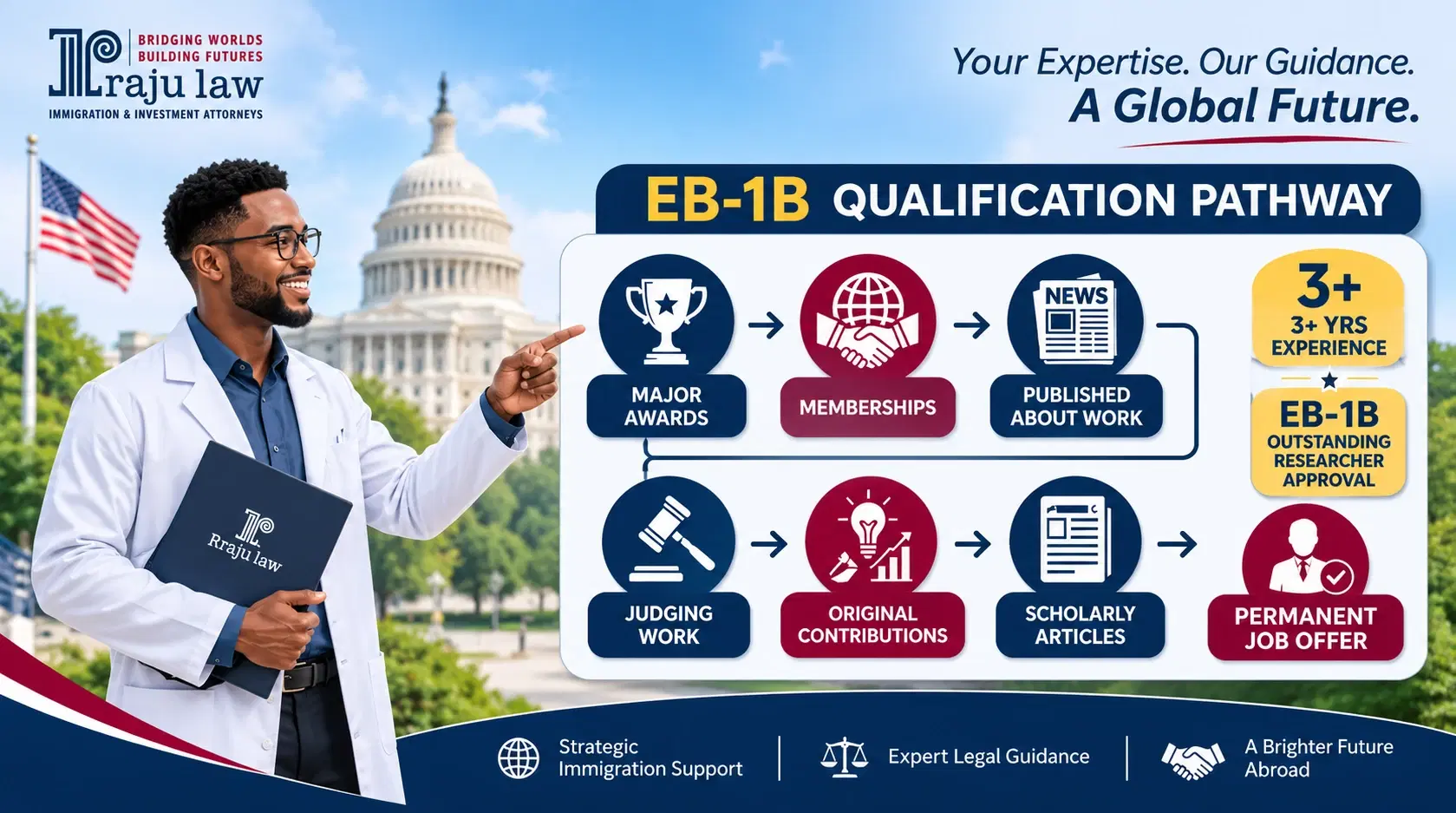
To prove international recognition, you must submit evidence meeting at least two of these six EB-1B criteria:
Major prizes or awards for outstanding achievement in your field
Membership in associations that require outstanding achievement of their members
Published material written by others about your work in professional publications
Judging the work of others, individually or on a panel, such as peer reviewing for journals
Original scientific or scholarly research contributions to the field
Authorship of scholarly books or articles in journals with international circulation
Most successful petitions rely heavily on peer review, original contributions, and scholarly publications. In conformity with current standards, your employer may additionally provide strong comparable evidence to demonstrate the criteria for international recognition that do not readily apply to the specific position you hold.''
How Does USCIS Evaluate the Evidence?
USCIS uses a two-step review. First, the officer checks whether your evidence meets at least two criteria. Second, the officer weighs all the evidence together to decide whether you are truly recognized internationally as outstanding.
This means two criteria is the minimum, not a guarantee. Citation records, independent expert letters, and proof that others have built on your work often make the difference at the second step.
How Does EB-1B Employer Sponsorship Work?
EB-1B employer sponsorship is mandatory. You cannot self-petition. Your employer files Form I-140 with the job offer letter and supporting evidence, and it controls the filing date, the offer terms, and whether to pay for premium processing. It can also withdraw the petition.
Once the I-140 is approved and your priority date is current, you can apply for adjustment of status inside the U.S. or go through consular processing abroad. If you change employers before receiving your green card, whether you need a new petition depends on timing. Under the AC21 portability rules, a new employer generally has to file a fresh I-140 if you move before your I-140 is approved or before your Form I-485 has been pending for 180 days. Once both conditions are met, you can usually move to a job in the same or a similar occupation by filing Form I-485 Supplement J, with no new I-140 required.
Talk with your HR or international office early, since many universities have internal policies on which roles they will sponsor. Working with an experienced immigration attorney can help both you and your employer avoid costly mistakes.
EB-1B vs EB-1A: Which Is Right for You?
Many academics weigh EB-1B vs EB-1A before filing. Here is how they compare:
Factor | EB-1B | EB-1A |
Who files | Employer only | Self or employer |
Job offer | Required (permanent) | Not required |
Evidence | 2 of 6 criteria | 3 of 10 criteria, or one major award |
Experience | 3 years teaching or research | No minimum |
Standard | Outstanding | Extraordinary (top of the field) |
Fields | Academic fields (sciences, arts, humanities, business, etc.) | Sciences, arts, education, business, athletics |
Labor certification | Not required | Not required |
In short, EB-1B has a lower evidentiary bar but ties you to an employer. EB-1A offers more freedom but demands a stronger record. Some researchers pursue both. An attorney who focuses on U.S. employment-based immigration can help you choose the right strategy.
How Can You Strengthen Your EB-1B Petition?
A few practical steps can make a real difference:
Aim for more than two criteria. Extra criteria give the officer more reasons to approve.
Get independent expert letters. Letters from respected experts who do not know you personally carry more weight.
Show impact with numbers. Citation counts, downloads, and use of your work by other researchers are strong proof.
Document peer review. Keep invitations and completion confirmations from journals and conferences.
Check the offer letter. Make sure it clearly states the position is permanent.
Ready to Start Your EB-1B Journey?
The EB-1B is a powerful option for professors and researchers with a growing international profile and a committed U.S. employer. Meeting the EB-1B requirements takes careful planning, strong evidence, and a well-organized petition.
At Raju Law, our team helps researchers and academic employers prepare EB-1B petitions that clearly present the applicant's achievements. Book a consultation today to find out whether you qualify and which green card path fits your goals.