Key Takeaways
In this article, you will learn:
What the H-2A visa is and which farm jobs qualify
The key H-2A employer requirements, from housing to the three-fourths guarantee
How the H-2A wage rate (AEWR) is set and why it is changing again
The step-by-step H-2A program timeline, from job order to first day of work
What H-2A fees employers pay to DOL and USCIS
Common mistakes that can delay or deny an H-2A application
What Is the H-2A Visa?
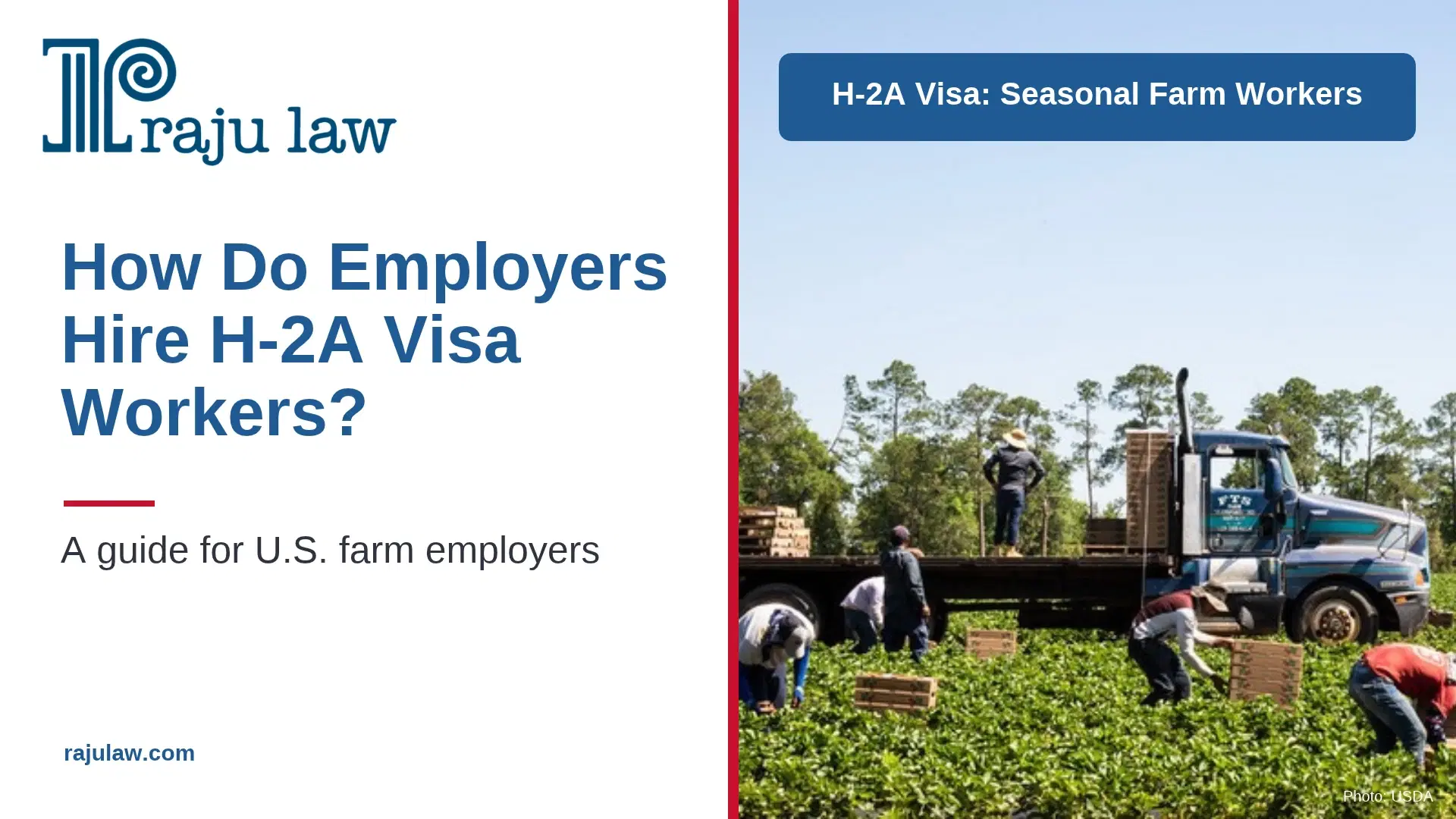
The H-2A visa is a temporary agricultural work visa. It lets U.S. farm employers, agents, and associations of agricultural producers bring foreign workers to the United States for temporary or seasonal agricultural jobs, such as planting, cultivating, and harvesting crops.
To use the H-2A program, an employer must show two things:
There are not enough able, willing, and qualified U.S. workers available for the job.
Hiring H-2A workers will not hurt the wages or working conditions of similar U.S. workers.
For a full overview of how Raju Law supports farm employers, visit our H-2A visa services page.
Is There an H-2A Cap?
No. Unlike the H-1B or H-2B visa, the H-2A program has no annual cap. Employers can hire as many workers as the Department of Labor (DOL) certifies, as long as every requirement is met.
How Long Can H-2A Workers Stay?
H-2A status is usually granted for the length of the certified job, generally up to one year. It can be extended in increments, but the total stay is capped at three years. After that, the worker must spend 60 days outside the U.S. before returning in H-2A status.
H-2A Employer Requirements
The H-2A program comes with strict worker protections. Employers agree to these H-2A employer requirements when they file for labor certification.
Pay at Least the Required Wage
Employers must pay at least the highest of the Adverse Effect Wage Rate (AEWR), the applicable prevailing wage, the agreed collective bargaining rate, or the federal or state minimum wage.
Provide Free Housing
Employers must provide free housing to workers who cannot reasonably return home each day. The housing must meet federal and state health and safety standards and is usually inspected before workers arrive.
Cover Transportation
Inbound and outbound travel: Pay for, or reimburse, travel from the worker's home country to the job and back.
Daily transportation: Provide free, safe transportation between the housing and the worksite.
Meals, Tools, and Insurance
Provide three meals a day or free, fully equipped kitchen facilities.
Supply all required tools, supplies, and equipment at no cost.
Carry workers' compensation insurance or equivalent coverage.
Honor the Three-Fourths Guarantee
Employers must offer each worker work hours equal to at least 75% of the workdays in the contract period. If they offer less, they must pay the difference as if the hours had been worked.
Keep Accurate Records
Employers must give workers an earnings statement each payday and keep payroll and hours records, generally for at least three years.
H-2A Wage Rate (AEWR) Explained
The H-2A wage rate (AEWR) is the minimum hourly wage that DOL sets so that foreign workers do not lower pay for U.S. farmworkers. It differs by state and job type.
How the AEWR Is Calculated Now
In October 2025, DOL issued an interim final rule that changed how AEWRs are set for most farm jobs. The new method:
Uses Occupational Employment and Wage Statistics (OEWS) data instead of the old USDA Farm Labor Survey
Sets skill-based wage levels for each occupation and area
Allows a housing adjustment that lowers the AEWR when employers provide free housing
For range livestock jobs, a separate monthly AEWR applies. As of February 3, 2026, it is $2,132.41 per month.
Why the AEWR Could Change Again
On August 26, 2026, a federal court in California found the 2025 AEWR method unlawful. The court did not cancel the rule right away, so it remains in effect for now. However, DOL has been ordered to issue a new method by December 30, 2026.
If the new rates come out higher, some employers could owe back wages. Employers should budget carefully and check current rates before each filing.
H-2A Program Timeline: Step by Step
Step 1: Plan Your Season (90–120 Days Out)
Confirm your start date, number of workers, worksites, and housing. Late planning is the most common reason seasons are missed.
Step 2: File the Job Order (75–60 Days Out)
Submit Form ETA-790/790A through DOL's FLAG system. The State Workforce Agency (SWA) reviews it and starts recruiting U.S. workers.
Step 3: Apply for Labor Certification (45+ Days Out)
File Form ETA-9142A with DOL's National Processing Center no fewer than 45 days before your first date of need. Filing later requires an emergency waiver, which is rarely approved.
Step 4: Recruit U.S. Workers
You must run positive recruitment and hire qualified U.S. applicants. In most cases, you must keep hiring qualified U.S. workers who apply until 50% of the contract period has passed.
Step 5: Receive DOL Certification
DOL generally issues a decision about 30 days before your start date.
Step 6: File Form I-129 With USCIS
File Form I-129 with the H-2A supplement. Under a recent DHS rule, employers may file once DOL issues a Notice of Acceptance, so USCIS review can run at the same time as DOL's.
Step 7: Visa Interview and Arrival
Workers abroad apply for the visa at a U.S. consulate, then travel to the U.S. and begin work on the certified start date.
H-2A Fees for Employers
Fee | Amount |
DOL labor certification | $100 per application + $10 per certified worker (max $1,000) |
Form I-129, named workers | 1,090(545 for small employers) |
Form I-129, unnamed workers | 530(460 for small employers) |
Asylum Program Fee | $600; $300 for small employers; $0 for nonprofits |
Fees as of November 2026. Always confirm current amounts on the USCIS fee schedule before filing.
Employers also pay the workers' visa and travel costs, either upfront or by reimbursement, plus housing and meal costs during the season.
Common H-2A Mistakes to Avoid
Filing too late: Missing the 60- and 45-day deadlines can cost you the season.
Housing problems: Failed inspections delay certification.
Wrong wage rate: Paying below the current AEWR can lead to back pay and penalties.
Poor records: Missing payroll or hours records are a top finding in DOL audits.
Unlisted worksites: Workers may only work at locations listed on the certification.
Serious violations can lead to fines and debarment from the H-2A program.
Frequently Asked Questions (FAQ)
What is the H-2A visa used for?
The H-2A visa lets U.S. employers hire foreign workers for temporary or seasonal agricultural jobs when not enough U.S. workers are available.
Is there a limit on H-2A visas each year?
No. The H-2A program has no annual cap, unlike the H-1B and H-2B programs.
What is the current H-2A wage rate (AEWR)?
It depends on the state, job, and skill level. DOL usually publishes new rates around July 1 each year. Because a court has ordered DOL to replace the current method by December 30, 2026, rates may change.
Do H-2A employers have to provide housing?
Yes. Employers must provide free housing that meets safety standards to workers who cannot return home each day.
How early should I start the H-2A process?
Start planning 90 to 120 days before you need workers. The job order must be filed 75 to 60 days before your start date.
Can H-2A workers get a green card?
H-2A is a temporary visa, but some employers later sponsor workers for permanent residence through the EB-3 green card for skilled and other workers.
What happens if I break H-2A rules?
DOL can order back wages, issue fines, and in serious cases bar the employer from the H-2A program.
Get Help With Your H-2A Application
The H-2A program has tight deadlines, detailed employer requirements, and wage rules that are changing again. One missed step can delay your workers past harvest. Raju Law helps farm employers plan, file, and stay compliant. Book an appointment to start planning your next season.
Disclaimer: This article is for general information only and is not legal advice. Immigration rules and fees change often; consult an attorney about your specific case.