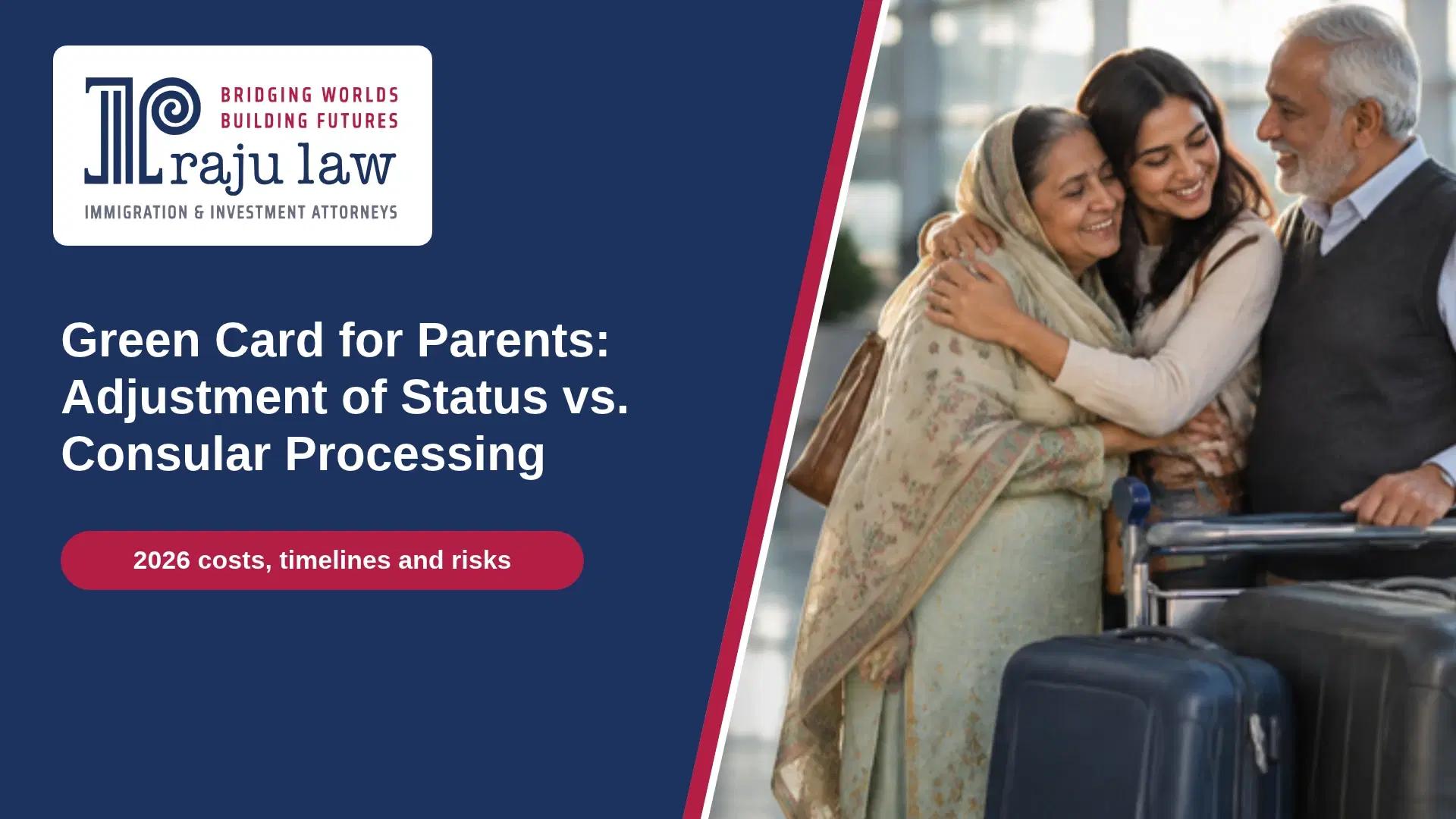
Nadia became a U.S. citizen last spring. The first thing she did after the oath ceremony? She called her parents in Sylhet and said, "Ammu, Abbu, it's time." Like thousands of new citizens, Nadia wanted a green card for parents so her mother and father could live with her in New York for good.
But her very next question stopped her cold. Her parents were already visiting her on tourist visas. Should they apply from inside the U.S., or go home and apply through the embassy in Dhaka?
That choice is called adjustment of status vs. consular processing, and in 2026 it matters more than ever. Let's walk through it together.
Key Takeaways
In this article, you will learn:
How to sponsor parents with Form I-130
How adjustment of status works inside the U.S.
How consular processing works abroad, including in Dhaka
2026 costs and IR-5 timelines for each path
Why the new 2026 USCIS memo adds risk for B-2 visitors
How to Sponsor Parents for a Green Card: The Basics
Parents of U.S. citizens are "immediate relatives." That means there's no annual cap and no years-long waiting line like siblings face. Once the petition is approved, a visa number is available right away.
To sponsor, you must be:
A U.S. citizen (green card holders can't sponsor parents)
At least 21 years old
Able to prove the parent-child relationship, usually with your birth certificate
Stepparents can qualify if their marriage to your parent happened before you turned 18. Adoptive parents generally qualify if the adoption happened before you turned 16. Not sure where you stand? Try Raju Law's green card eligibility check or read more on our green card for parents page.
Step 1: File the I-130 for parents
Every case starts with Form I-130, Petition for Alien Relative. You file one petition per parent, so two parents means two forms and two fees. As of late 2026, the fee is $675 on paper or $625 online, according to the USCIS fee schedule.
Step 2: Show you can support them
You'll also file Form I-864, Affidavit of Support. It's a legal promise that your parents won't rely on public benefits. Your income must meet 125% of the federal poverty guideline for your household size (I-864P). If it falls short, a joint sponsor can help.
After that, the road splits in two.
Path 1: Parent Green Card Adjustment of Status
Adjustment of status lets a parent who is already in the U.S. become a permanent resident without leaving. You file Form I-485 with USCIS, often at the same time as the I-130 (called concurrent filing).
How it works
File the I-130 and I-485 together, plus the I-864 and a medical exam from a USCIS civil surgeon.
Attend a biometrics appointment for fingerprints and photos.
Attend an interview at a local USCIS office, if one is scheduled.
Receive the green card by mail.
Parents can also request a work permit (I-765) and a travel document (I-131) while they wait.
The pros
Your parents stay with you during the whole process.
Immediate relatives are generally forgiven for overstays or working without permission, if they entered legally.
The catch in 2026
On May 21, 2026, USCIS issued policy memo PM-602-0199. It reminds officers that adjustment of status is discretionary, not automatic. Officers now look harder at people who entered on single-intent visas like the B-2 tourist visa, especially if they filed soon after arrival.
Why does that matter? When your parents got their B-2 visas, they told the consular officer they'd visit and return home. If they file for a green card two weeks after landing, USCIS may see "preconceived intent" to immigrate. That can lead to tough interviews, requests for evidence or even denial.
Path 2: Consular Processing for Parents Abroad
With consular processing, your parents get an immigrant visa (IR-5) at a U.S. embassy in their home country, then enter the U.S. as permanent residents.
How it works
USCIS approves your I-130 and sends the case to the National Visa Center (NVC).
You pay NVC fees and submit the DS-260 application, civil documents and I-864 online.
Your parents complete a medical exam with an embassy-approved doctor.
They attend the interview. In Dhaka, the embassy now uses two-day processing for immigrant visas: a document review first, then the interview (embassy instructions).
They pay the USCIS Immigrant Fee, fly to the U.S. and receive the green card by mail.
The pros
It's the "normal" path the law expects, so there's no discretion issue about visa intent.
It's usually cheaper than adjustment of status.
The cons
Your parents must wait abroad until the interview.
Anyone who stayed in the U.S. unlawfully for more than 180 days may trigger a 3- or 10-year bar by leaving. Never travel before talking to a lawyer.
Consular Processing vs. Adjustment of Status: Side by Side
Factor | Adjustment of status | Consular processing |
Where parents wait | In the U.S. | In their home country |
Main government fees (per parent) | I-130 625–675 + I-485 $1,440 (+ optional I-765 $260 and I-131 $630) | I-130 625–675 + NVC $325 visa fee + $120 I-864 review + $235 USCIS Immigrant Fee |
Medical exam | USCIS civil surgeon in the U.S. | Embassy panel physician (about BDT 9,500 in Dhaka for adults) |
Interview | Local USCIS office | U.S. embassy or consulate |
2026 risk | Higher scrutiny for B-2 visitors under the new memo | Possible delays from embassy backlogs or 221(g) |
Best for | Parents in valid status with a clean history | Parents abroad, or visitors who just arrived |
Fees are from the USCIS fee schedule and the State Department's visa fee page as of October 2026. Check both before you pay.
IR-5 Visa Processing Time in 2026
There's no official single number, but most parent cases take about 12 to 24 months from I-130 filing to green card. A rough breakdown for consular cases:
USCIS I-130 review: several months to over a year. Check the latest on USCIS processing times.
NVC document review: about 2 to 4 months, faster if your documents are complete.
Embassy interview: a few weeks to several months, depending on the post.
Adjustment cases often land in a similar range, but local USCIS office backlogs vary a lot. If your case stalls far beyond normal times, a writ of mandamus can push the agency to act.
Back to Nadia: Which Path Did She Choose?
Nadia's parents had arrived on B-2 visas just three weeks earlier. Under the 2026 memo, filing for adjustment so quickly could look like they'd planned to stay all along. So after a consultation, they enjoyed their visit, flew home on time and went through consular processing in Dhaka. It took a bit longer, but the case stayed clean and low-risk.
Your family's best path may be different. Status, travel history, health and timing all play a role.
Frequently Asked Questions
1. Can a green card holder sponsor parents?
No. Only U.S. citizens who are at least 21 can file an I-130 for parents. If you hold a green card, you'll need to become a citizen through naturalization first.
2. Do I need to file a separate I-130 for each parent?
Yes. Each parent needs their own I-130 and fee. Because each parent is the main applicant on their own petition, you'll also prepare a separate I-864 for each one, and each parent pays their own I-485 or visa fees.
3. Can my parents apply for a green card while visiting on a tourist visa?
It's legally possible, but risky in 2026. Under the May 2026 USCIS memo, filing soon after arriving on a B-2 visa can be seen as misusing the visa. Get legal advice before filing anything.
4. What is the IR-5 visa processing time from Bangladesh?
Most cases take about 12 to 24 months in total. Since 2026, the Dhaka embassy uses two-day processing, so plan for two visits. Our IR-5 visa overview covers the basics, and Raju Law's Immigration News page tracks policy changes affecting Bangladeshi applicants.
5. Can my parents work after getting a green card?
Yes. As permanent residents, they can live and work anywhere in the U.S. After five years, they may apply for citizenship themselves. Just remember to renew the green card before its 10-year expiry.
Ready to Bring Your Parents Home?
A green card for parents is one of the most rewarding cases in immigration law. But the path you choose, adjustment of status or consular processing, can make the difference between a smooth approval and a painful denial. That's especially true under 2026's stricter rules.
Raju Law's family immigration team works with families in the U.S. and Bangladesh. Our team can review your parents' visa history, pick the safer path and handle every form from the I-130 to the interview. We also have an office in Dhaka for families going through the embassy.
Book a consultation with Raju Law today, or review our legal fees to plan your case.