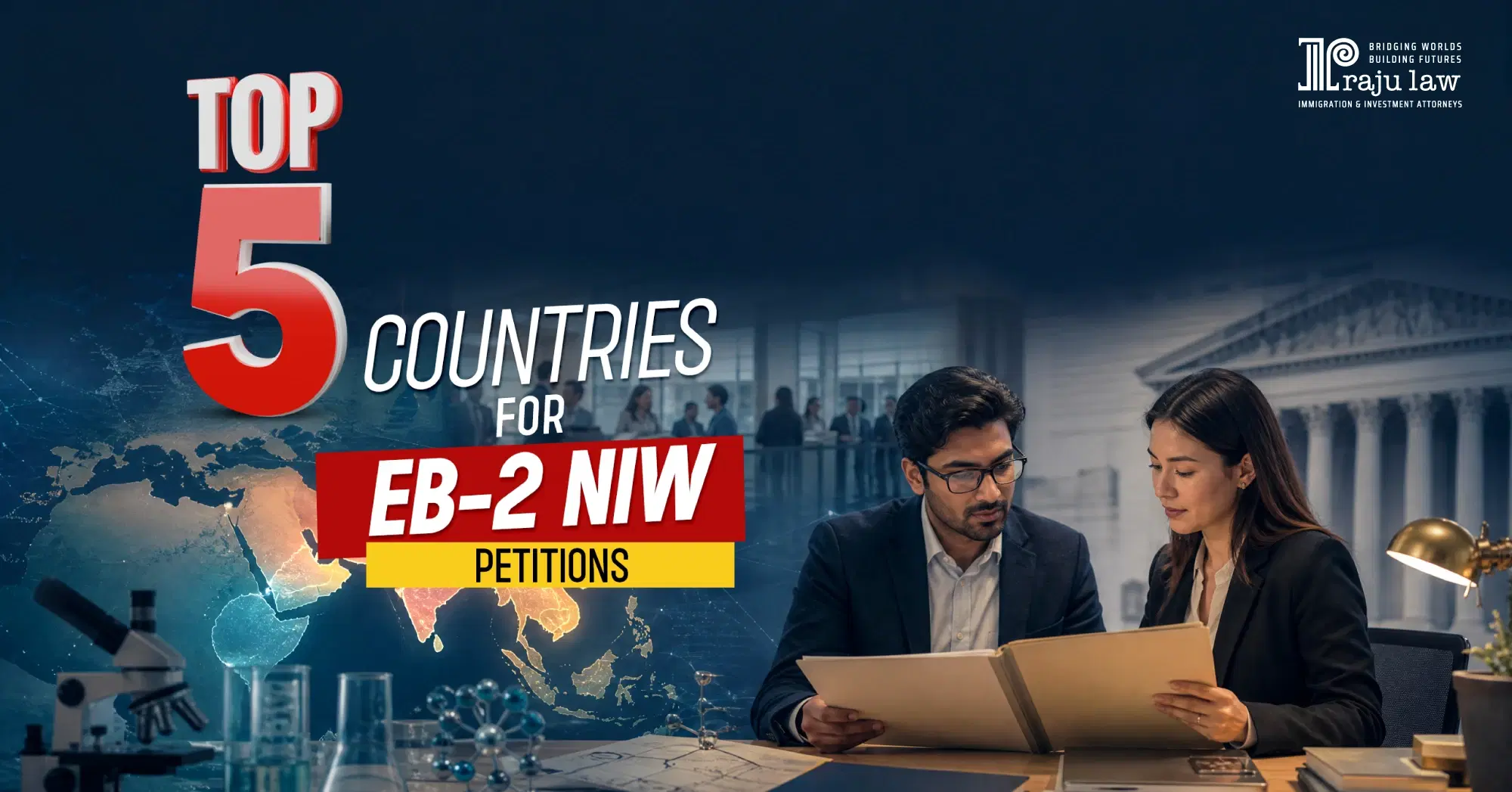
China filed the most EB-2 NIW petitions in fiscal year 2025, followed by India, Iran, Nigeria, and Bangladesh. Together these five countries account for most of the growth behind the 66,276 petitions USCIS received that year. Country of birth does not affect eligibility, but it does affect how closely officers review common patterns in a petition.
China alone accounted for roughly 18 percent of all EB-2 NIW petitions filed that year. The reasons behind each country’s numbers differ, from research output to backlog pressure to limited opportunity at home.
KEY TAKEAWAYS
China and India together filed more EB-2 NIW petitions than most other countries combined.
Each top country files for a different reason: research volume, backlog pressure, or limited opportunity at home.
Country of birth does not affect NIW eligibility, but high filing volume increases scrutiny of common evidence patterns.
Which country files the most EB-2 NIW petitions?
China filed the most EB-2 NIW petitions in fiscal year 2025, with 12,081 filings and 5,091 approvals. India was second with 9,196 filings and 2,892 approvals. Iran, Nigeria, and Bangladesh rounded out the top five.
USCIS reported 66,276 total EB-2 NIW petitions for fiscal year 2025. China’s petitions alone made up roughly 18 percent of that total. The top five countries together accounted for well over half of all filings.
The pending backlog also grew during the same period. USCIS reported 74,392 pending EB-2 NIW cases by the end of fiscal year 2025, a 31 percent increase from the start of the year. These figures cover petitions filed from abroad and from applicants already inside the United States on another visa status, since USCIS does not publish a separate breakdown by where the applicant was living at the time of filing.
Country | Petitions filed FY2025 | Approvals FY2025 | Share of total |
|---|---|---|---|
China | 12,081 | 5,091 | About 18% |
India | 9,196 | 2,892 | About 14% |
Iran | 3,871 | 1,681 | About 6% |
Nigeria | 3,584 | 1,187 | About 5% |
Bangladesh | 2,621 | 878 | About 4% |
Why does China lead EB-2 NIW filings by such a wide margin?
China leads because it produces the largest pool of U.S. trained doctorate holders of any country. Chinese students earned 5,981 U.S. science and engineering doctorates in 2023, more than the next four countries combined.
China’s domestic research spending grew 8.7 percent in 2023, according to OECD data, far outpacing the roughly 1.7 percent growth rate in the United States that year. That investment has produced a large pipeline of PhD level researchers with U.S. training.
China’s EB-2 category also carries a significant priority date backlog under the standard track. An approved NIW petition still requires an available visa number before adjustment of status, but it lets applicants petition on their own without an employer sponsor. The picture looks different for Chinese applicants filing EB-1A, the extraordinary ability category, which does not require the same national interest analysis and has historically moved faster than EB-2 for China.
Why does India file so many EB-2 NIW petitions if the visa backlog does not improve?
India files the second highest number of EB-2 NIW petitions because the NIW pathway removes the labor certification step. It does not shorten the visa number wait, but it lets applicants control their own timeline without depending on an employer sponsored PERM process.
Indian chargeable EB-2 petitions face some of the longest priority date waits in the employment based system under the standard track. Many applicants already expect a wait measured in years regardless of which pathway they use, so the NIW route lets them petition on their own and skip PERM entirely rather than adding a labor certification process on top of a wait they cannot shorten either way.
Approval rates for India chargeable petitions have declined more sharply than most other filing pools as scrutiny under Prong 2 has increased. A strong academic record alone is drawing more requests for evidence than it did two years ago. For example, an applicant born in India with an approved I-140 in the standard EB-2 category may wait more than a decade for a visa number, while the NIW route reaches the same visa number line but without ever filing PERM.
Why are Iran, Nigeria, and Bangladesh among the top five?
Iran, Nigeria, and Bangladesh rank in the top five because each sends a large share of its most educated citizens abroad. Limited research funding, sanctions, or low domestic research investment push skilled applicants toward the United States rather than staying in the home country workforce.
Iran ranks 19th globally for scientific publication output. International sanctions and limited domestic research funding have pushed much of Iran’s doctoral talent to build careers abroad. Fewer than 8 percent of Iranian doctoral recipients on temporary U.S. visas told the National Science Foundation they intend to return home.
Nigeria’s applicant pool is unusually credentialed. Roughly 29 percent of Nigerian nationals in the United States hold a master’s, doctoral, or graduate level professional credential, compared to about 11 percent of the general U.S. population.
Bangladesh’s growth is tied to limited domestic research investment, at roughly 0.30 percent of GDP, and a sharp rise in Bangladeshi enrollment at U.S. universities. That enrollment grew nearly 18 percent in a single year, according to Open Doors international student data. This pattern does not apply equally within each country, since applicants from all three still need endeavor specific evidence for Prong 2. National origin explains filing volume, not individual case strength.
Country | Key Driver | Notable Figure |
|---|---|---|
Iran | Sanctions and limited research funding | Fewer than 8% of doctoral recipients plan to return home |
Nigeria | Highly credentialed population | About 29% hold a graduate degree, versus about 11% nationally |
Bangladesh | Low domestic research investment | University enrollment up almost 18% in one year |
Does country of birth affect EB-2 NIW eligibility?
No. The Dhanasar framework evaluates the merits of the proposed endeavor and the applicant’s qualifications, not nationality. Country of birth only affects visa number availability after approval, through the per country priority date system.
USCIS officers apply the same three prong Dhanasar standard to every EB-2 NIW petition, regardless of where the applicant was born. National importance, positioning to advance the endeavor, and the balance of factors are evaluated on the merits of each case.
A common misconception is that applicants from high filing countries face a higher bar. That is not accurate as a matter of policy. The one place nationality does matter is after approval: China and India chargeable applicants face significant backlogs before a visa number becomes available, while most other countries are current or close to current. The EB-2 China final action date, for example, was frozen at September 1, 2021 as of the July 2026 Visa Bulletin, while most other countries in EB-2 were current the same month.
What does high filing volume from these countries mean for petition strategy?
High filing volume means officers have seen the common evidence patterns from these countries many times. A petition that reads as interchangeable with hundreds of others from the same country and field is more likely to draw a request for evidence.
Petitions built primarily on citation counts and general field recognition have drawn more scrutiny industry wide since the Prong 2 standard tightened. That pattern is most visible in the highest volume filing countries, where the same template appears most often.
Endeavor specific evidence stands out from that template regardless of where the applicant was born. Grant funding tied to the proposed work, signed agreements, patents, and recommendation letters that address the specific endeavor all separate a petition from the common pattern. This does not mean applicants from lower volume countries can rely on generic evidence either. The standard is the same for every applicant; it is simply less visible when the surrounding filing pool is smaller.
Lead with the specific proposed endeavor, not general academic standing
Tie any citation record or credential to that specific endeavor
Use recommendation letters that address the endeavor directly
Include traction evidence: funding, patents, agreements, or pilots tied to the endeavor
Review your draft petition and ask whether it could be mistaken for someone else’s case in the same field and country. If yes, add the specific evidence that makes it yours.
Frequently Asked Questions
Q: Does filing from a high volume country lower my approval odds?
A: Not by policy. USCIS applies the same Dhanasar standard to every applicant. High filing volume increases exposure to scrutiny of common evidence patterns, not the legal standard itself.
Q: How many EB-2 NIW petitions did USCIS receive in fiscal year 2025?
A: USCIS received 66,276 EB-2 NIW petitions in fiscal year 2025, a 4.3 percent increase over the prior year.
Q: What was the EB-2 NIW approval rate for fiscal year 2025?
A: The approval rate fell to 55.2 percent for fiscal year 2025, down from about 71 percent the year before.
Q: Why did the EB-2 NIW approval rate fall so much in fiscal year 2025?
A: Approval rates declined through the year as officers applied closer scrutiny to petitions built mainly on citation counts or general field recognition rather than evidence tied to the specific proposed endeavor.
Q: Is China’s high EB-2 NIW filing volume connected to its visa backlog?
A: Yes. China’s EB-2 priority date backlog makes the self petition flexibility of the NIW pathway more attractive than the standard employer sponsored track.
Q: Does the NIW pathway make sense for India chargeable applicants if the wait does not improve?
A: For many applicants, yes, because it removes the labor certification step and lets the applicant control the timeline, even though it does not shorten the visa number wait itself.
Q: Why do Iran, Nigeria, and Bangladesh appear in the top five despite smaller populations than China or India?
A: Each country sends a disproportionate share of its most educated citizens abroad due to limited research funding, sanctions, or low domestic research investment, which produces a large pool of qualified NIW applicants relative to population size.
Additional Links:
USCIS, Adjustment of Status Filing Charts : https://www.uscis.gov/green-card/green-card-processes-and-procedures/visa-availability-priority-dates/adjustment-of-status-filing-charts-from-the-visa-bulletin
USCIS, Employment-Based Immigration: Second Preference EB-2 : https://www.uscis.gov/working-in-the-united-states/permanent-workers/employment-based-immigration-second-preference-eb-2
USCIS, Immigration and Citizenship Data : https://www.uscis.gov/tools/reports-and-studies/immigration-and-citizenship-data