When someone is facing danger, abuse, a serious crime, or an urgent crisis, immigration is no longer just paperwork. It becomes personal. It may involve safety, family separation, medical needs, trauma, or the fear of being forced to depend on someone who caused harm.
In these situations, many people hear about humanitarian parole, the U Visa, or VAWA and wonder: which one actually applies to me?
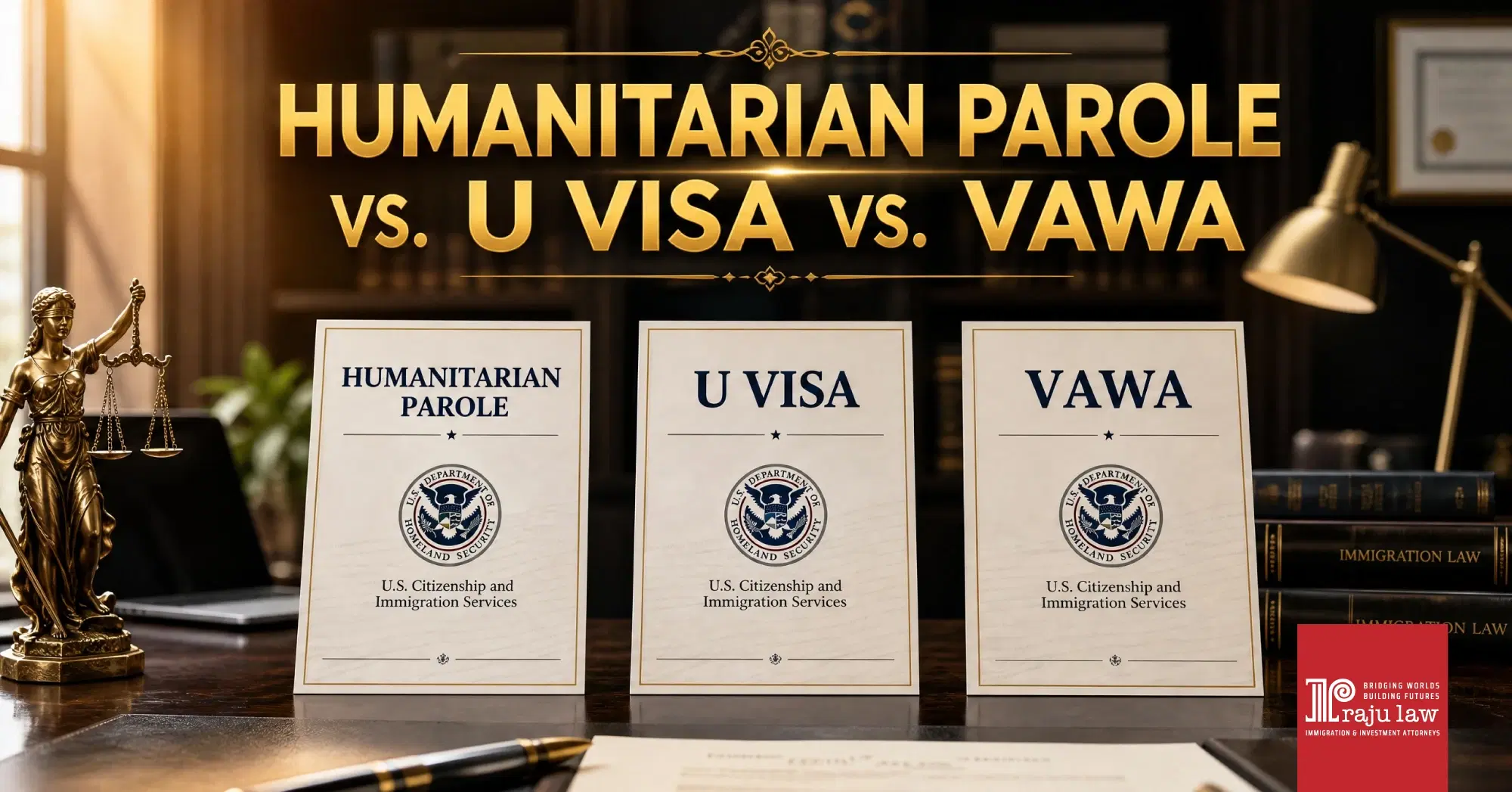
In 2026, these three immigration options remain important forms of protection, but they are not the same. Humanitarian parole may help someone enter the United States temporarily for an urgent reason. A U Visa may help certain victims of qualifying crimes who cooperate with law enforcement. VAWA may help certain abused family members apply without relying on the abusive U.S. citizen or green card holder.
This article explains what each option may allow, what restrictions applicants should understand, and how to think about the right pathway before filing.
What’s Allowed: Key Pathways and Benefits
VAWA Self-Petitioning for Certain Abused Family Members:
VAWA may allow certain abused spouses, children, and parents of U.S. citizens or lawful permanent residents to file an immigration petition on their own. This means the abusive family member does not need to sign the petition, support the case, participate in the process, or even know that the case has been filed.
This can be life-changing for survivors whose immigration status was used as a tool of control. VAWA may apply in cases involving battery or extreme cruelty, including physical abuse, emotional abuse, threats, isolation, financial control, coercion, or immigration-related manipulation.
Despite the name, VAWA protection is not limited to women. Qualifying applicants may seek protection regardless of gender, as long as they meet the legal requirements.
U Visa Relief for Victims of Qualifying Crimes:
A U Visa may be available to victims of certain qualifying crimes who suffered substantial physical or mental abuse and were helpful, are being helpful, or are likely to be helpful to law enforcement or another certifying authority.
This option may apply in cases involving domestic violence, sexual assault, felonious assault, trafficking, abduction, extortion, blackmail, and other qualifying criminal activity. A U Visa can provide temporary status, work authorization, and a possible path to a green card after the applicant has maintained U nonimmigrant status for the required period.
Humanitarian Parole for Urgent Temporary Entry:
Humanitarian parole may allow a person outside the United States to request temporary entry for urgent humanitarian reasons or significant public benefit. This may involve emergency medical treatment, urgent family circumstances supported by evidence beyond a general desire for family reunification, participation in legal proceedings, or another serious time-sensitive situation.
However, humanitarian parole is not a regular visa, admission, or green card. It is temporary and discretionary. It may help someone enter the United States for a specific urgent purpose, but it does not automatically solve the person’s long-term immigration status.
Protection Without the Abuser’s Control:
One of the strongest features of VAWA is independence. A qualifying applicant does not have to depend on the abusive family member to file the case. For many survivors, this creates a safer way to seek immigration protection without giving the abuser power over the process.
Possible Work Authorization Depending on the Category:
Work authorization may be available in certain humanitarian cases, but the rules are different for each option. U Visa applicants and qualifying derivatives may have employment authorization options. VAWA self-petitioners may also qualify for work authorization depending on the stage of the case and related filings. Humanitarian parolees may need to apply separately for employment authorization unless a specific parole program provides otherwise.
What’s Not Allowed: Crucial Restrictions and Limitations
Do Not Treat Humanitarian Parole as a Green Card by Itself:
Humanitarian parole is temporary. It does not automatically convert into permanent residence. Once the parole period ends, the person may need to depart the United States unless another lawful basis allows them to remain or adjust status.
Do Not File a U Visa Without the Required Certification:
A U Visa is not granted simply because someone was harmed. The applicant must show that the crime qualifies, that substantial physical or mental abuse occurred, and that the applicant has been helpful, is being helpful, or is likely to be helpful to law enforcement.
A properly signed Form I-918, Supplement B, is a critical part of the U Visa process. Without a valid certification from a qualifying official, the petition can face serious problems or denial.
Do Not Assume Every Crime Qualifies for a U Visa:
Not every painful or harmful experience meets the U Visa standard. The criminal activity must fall within the qualifying categories under the law or be substantially similar to a qualifying crime. The crime must also generally have occurred in the United States or violated U.S. law.
Do Not File VAWA Against an Abuser Who Does Not Meet the Required Immigration Category:
VAWA self-petitioning generally requires a qualifying relationship with an abusive U.S. citizen or lawful permanent resident spouse, parent, or child. If the abuser is undocumented or only holds temporary nonimmigrant status, such as F-1 or H-1B, VAWA may not be the correct pathway, although other options may still be worth reviewing.
Do Not Assume Every Difficult Relationship Qualifies for VAWA:
VAWA is not based on ordinary relationship conflict. The case must show a qualifying family relationship, battery or extreme cruelty, good moral character, and other required elements. The evidence should clearly explain both the relationship and the abuse.
Tip for 2026
In VAWA, U Visa, and certain related survivor-based cases, confidentiality protections are extremely important. The government generally cannot disclose protected information to the abuser, perpetrator, or certain unauthorized parties. This protection can help survivors pursue immigration relief without giving the person who caused harm control over the case.
For any humanitarian or survivor-based filing, keep a clear timeline and supporting records. Save police reports, court records, medical records, protection orders, messages, photos, affidavits, counseling records, shelter records, proof of relationship, proof of residence, and any evidence showing urgency, harm, abuse, or cooperation with law enforcement.
At Raju Law, we generally advise clients not to choose the immigration category first and then force the facts into it. The better approach is to review the facts carefully, understand the legal standard, and then select the strongest available pathway.
Final Thoughts
Humanitarian immigration options exist because some situations require protection, urgency, and careful legal attention. But not every humanitarian case fits the same pathway.
Humanitarian parole may help someone seek temporary entry for an urgent reason. A U Visa may help a victim of qualifying criminal activity who cooperates with law enforcement. VAWA may help certain abused family members seek protection without depending on the abuser.
The right option depends on where the person is located, what happened, who caused the harm, what evidence is available, and what long-term immigration goal is realistic.
At Raju Law, we handle humanitarian and survivor-based immigration cases with care, confidentiality, and strategy. We help clients evaluate sensitive facts, identify the strongest available pathway, prepare supporting evidence, and pursue immigration protection with the attention these cases deserve.
If you or a loved one may qualify for humanitarian parole, a U Visa, or VAWA protection, contact Raju Law to evaluate your options and take the next step with proper legal guidance.