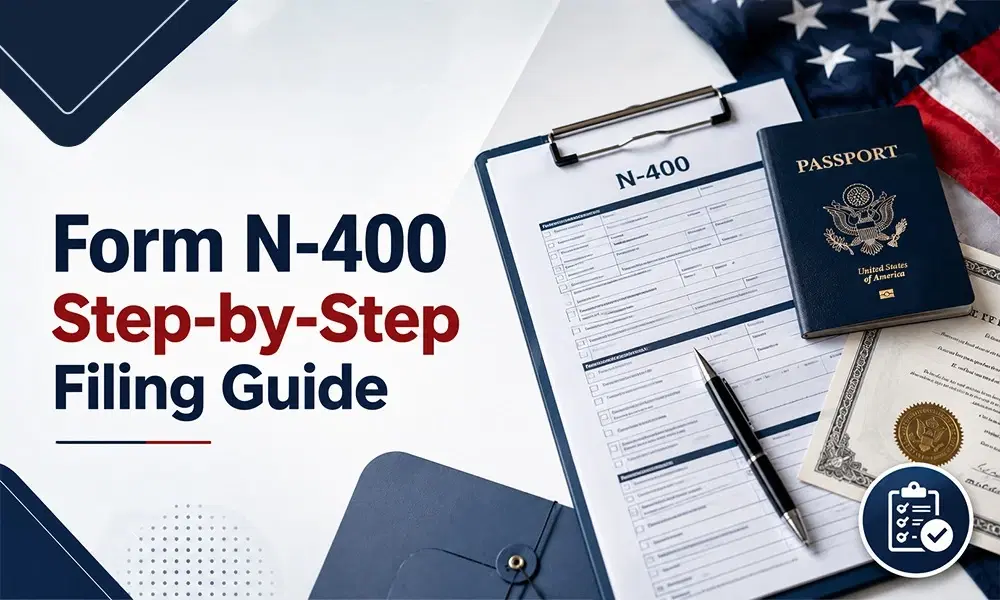
Becoming a U.S. citizen is one of the most significant milestones in an immigrant's life. If you have been a Lawful Permanent Resident (green card holder) for the required number of years, you may be eligible to apply for citizenship through the naturalization process. The primary form you will need is Form N-400, officially called the Application for Naturalization.
This guide walks you through every stage of the process — from confirming your eligibility to attending your oath ceremony — so you know exactly what to expect and how to prepare.
Before You File: Confirm Your Eligibility
Do not file Form N-400 until you have confirmed that you meet all of the following requirements. Filing prematurely can result in denial and loss of the filing fee.
Basic Requirements for All Applicants
Age: You must be at least 18 years old at the time of filing. (Children may acquire citizenship through a parent — see Form N-600.)
Lawful Permanent Resident (LPR) status: You must hold a valid, unexpired green card. If your card has expired or been lost, renew or replace it before filing.
Good Moral Character (GMC): Demonstrated throughout the statutory period (5 or 3 years). GMC issues are the most common reason for naturalization denials.
English proficiency: Ability to speak, read, and write basic English (exemptions apply — see below).
Civics knowledge: Must pass the U.S. history and government test (exemptions apply).
Attachment to the Constitution: Willingness to take the Oath of Allegiance to the United States.
Residency and Presence Requirements
5-Year Rule (Standard — most applicants):
Continuous residence in the U.S. for at least 5 years as an LPR
Physical presence for at least 30 months (913 days) out of the last 5 years
Resided within the USCIS district for at least 3 months before filing
3-Year Rule (Marriage-based):
Must be married to, and living with, a U.S. citizen for the full 3-year period
Continuous residence for at least 3 years
Physical presence for at least 18 months (548 days) out of the last 3 years
Important: Continuous residence and physical presence are calculated separately. Absences of 6 to 12 months raise a presumption of a break in continuous residence. Absences of 1 year or more break continuous residence automatically.
Exemptions
English test exemptions: Age 50+ with 20 years as an LPR (50/20 rule); or age 55+ with 15 years as an LPR (55/15 rule). You may still take the civics test in your native language with an interpreter.
English and civics exemption: Applicants with a qualifying physical or developmental disability may file Form N-648 (Medical Certification for Disability Exceptions) with their N-400.
Military service: Special rules apply for U.S. armed forces members, including shorter residency requirements.
Step 1: Complete Form N-400
Form N-400 is available on the USCIS website at uscis.gov. It collects your personal history including employment, addresses, travel outside the U.S., marital history, and any criminal or legal issues. Accuracy is critical — any inconsistency between your N-400 and prior immigration filings will be scrutinized at your interview.
Filing Options
Online filing: Create an account at uscis.gov to submit and track your application electronically. The online filing fee is $710.
Paper filing: Download, print, and complete Form N-400 by hand. Mail to the USCIS address for your state. The paper filing fee is $760.
Filing Fee (as of May 2026): $710 online / $760 paper. Verify the current fee schedule on uscis.gov before submitting, as fees are subject to change.
Key Sections of the N-400
Part 1–3: Personal information, basis for application, and biographic information.
Part 4: Continuous residence — you must meet the threshold before your filing date, not your interview date.
Part 5–6: Continuous residence exceptions and employment history.
Part 7: Travel outside the U.S. — list every trip in the past 5 years (or 3 years). Missing, estimated, or inconsistent dates create credibility issues.
Part 8–9: Marital history and information about children.
Part 10: Moral character questions — answer every question honestly. Hiding any arrest, charge, or conviction — regardless of outcome or expungement — is treated as misrepresentation and is itself grounds for denial.
Step 2: Gather Supporting Documents
Every N-400 must be accompanied by supporting documents. Below is a complete checklist organized by category.
Required for All Applicants
Copy of your Permanent Resident Card (green card), both sides
Copy of all pages of your current and prior passports covering the statutory period
IRS tax transcripts for each year of the statutory period (especially important if you traveled outside the U.S. for more than 6 months)
Good Moral Character — Criminal History Documentation
If you have any past encounters with law enforcement, provide the following based on your situation:
If arrested but no charges were filed:
Arrest report
Official statement from the arresting agency or court confirming no charges were filed
If charges were filed:
Arrest reports, charging documents, court dispositions, and sentencing records for each incident
Additional evidence regarding the circumstances of the arrest
If convicted and sentenced:
Sentencing record for each incident
Evidence of completion of sentence, probation, or parole
If conviction was vacated or expunged:
Motion to vacate and court order
Pardon application and final decision (if applicable)
Traffic incidents (only if involving alcohol/drugs, arrest, or serious injury):
All related documentation for the incident
Tax or financial obligations:
Documentation of any court-ordered fines, restitution, or wage garnishment
Evidence of payment or current payment arrangements
Continuous Residence — Evidence of U.S. Ties (If You Traveled 6–12 Months)
Rent or mortgage statements
Bank, credit card, or loan statements showing regular U.S. transactions
Car registration and insurance documents
IRS tax transcripts
Passport with entry and exit stamps
Any other documents proving your domicile remained in the United States
Spouse of a U.S. Citizen (3-Year Rule Applicants)
Copy of your marriage certificate
Evidence of spouse's U.S. citizenship (birth certificate, Certificate of Naturalization, or U.S. passport biographical page)
Divorce decrees or death certificates terminating any prior marriages (yours or your spouse's)
If spouse is employed abroad: evidence of employment, travel orders, and documentation that employment is ongoing
Disability Exception (Form N-648)
Form N-648 must be completed by a licensed medical doctor, osteopathic doctor, or licensed clinical psychologist
Submit Form N-648 together with your N-400 at the time of filing
If the disability develops after filing, provide evidence supporting late submission
Step 3: Submit Your Application
Once your N-400 is complete and all supporting documents are assembled, submit your application with the correct filing fee. After submission, USCIS will mail you a receipt notice (Form I-797) confirming they have received your application. Keep this notice — it is your proof of filing and can be used to check your case status online.
Tip: Check your case status regularly at uscis.gov/case-status. USCIS will send all correspondence to the address on your application — update your address immediately if you move (Form AR-11 on online address change from MyUscis.gov).
Step 4: Biometrics Appointment
After USCIS receives your application, they will schedule you for a biometrics appointment at a USCIS Application Support Center (ASC). You will receive an appointment notice (Form I-797C) in the mail.
What Happens
USCIS will collect your fingerprints, photograph, and signature. This information is used for an FBI background check and identity verification. Do not miss this appointment — it is required to move your application forward.
Step 5: The Naturalization Interview
Once your biometrics are processed and your background check clears, USCIS will schedule your naturalization interview. The average processing time from filing to interview is 6.5 to 12 months, though this varies by USCIS field office and case complexity.
What the Officer Will Do?
Verify your identity using original documents.
Review your N-400 line by line. The officer will ask you to confirm the information on your application. Know your application thoroughly before you walk in — any inconsistency will be probed.
Administer the English test. Speaking ability is assessed throughout the conversation. You will be asked to read one sentence aloud and write one sentence in English.
Administer the civics test. 20 questions from the 128-question bank. You must answer at least 12 correctly to pass.
Issue a decision. The officer may approve your application that day, continue it pending additional evidence, or in rare cases issue a denial.
Civics Test (2025): Applies to all N-400 filed on or after October 20, 2025. 128 questions in the bank; 20 asked; 12 correct required to pass.
If you fail: USCIS will schedule a second interview — typically within 60 to 90 days — where you are retested only on the failed portion. If you fail again, your application will be denied. You may then file a new N-400.
If Your Application Is Denied
USCIS will send you a notice explaining the reasons for denial. You have the right to request a hearing within 30 days using Form N-336 (Request for a Hearing on a Decision in Naturalization Proceedings under INA § 336). A denial does not affect your green card — you remain a Lawful Permanent Resident.
Step 6: The Oath Ceremony
The oath ceremony is the final step in becoming a U.S. citizen. Following approval of your N-400, USCIS will schedule your ceremony — typically within 2 to 6 weeks of your interview.
What Happens
You take the Oath of Allegiance to the United States, renouncing allegiance to all other countries.
Your green card is surrendered and canceled by the USCIS officer.
You receive your Certificate of Naturalization. This is your proof of U.S. citizenship. Keep it in a safe place.
You are now a U.S. citizen. You may immediately apply for a U.S. passport.
Name change: If you requested a legal name change on your N-400, the court will process it at the oath ceremony at no additional cost.
Processing Times and What Can Cause Delays
Average processing time for Form N-400 is 8 to 10 months from filing to oath ceremony, though this varies by field office and individual circumstances.
Common Causes of Delay
Incomplete application or missing supporting documents
Failure to respond promptly to USCIS requests for evidence (RFEs)
Criminal history requiring additional background checks
Extended travel history requiring additional review
Inconsistencies between the N-400 and prior immigration filings
Address change not reported to USCIS
Red Flags That Complicate Applications
Our attorneys conduct a thorough eligibility review before filing every N-400. These are the issues that most commonly result in delays or denials:
Prior immigration fraud or material misrepresentation on any application, visa, or entry
Extended absences from the United States, particularly over 180 days
Unfiled or improperly filed tax returns during any year of LPR status
Any criminal history — arrests, charges, convictions, or dismissed cases — not disclosed on the N-400
Pending court matters or outstanding warrants at the time of filing
Inconsistencies between the N-400 and any prior immigration applications or petitions
Failure to register for Selective Service (for eligible males who were LPRs between ages 18–26)
Frequently Asked Questions
Can I apply for N-400 without a green card?
No. You must have a valid, unexpired Permanent Resident Card to file Form N-400. If your green card has expired or been lost, you must renew or replace it before filing.
Do I need to include traffic tickets on my N-400?
It depends. Minor parking violations generally do not need to be disclosed. However, moving violations — especially those resulting in a court appearance, fine, or citation — should be discussed with your attorney. When in doubt, disclose. Failure to disclose is treated as misrepresentation.
I did not file taxes for two years when I was unemployed. Will this affect my application?
Potentially yes. USCIS may find that failure to file required tax returns — even during unemployment — reflects negatively on Good Moral Character. If you were legally required to file, get into compliance before submitting your N-400.
If my citizenship application is denied, what happens to my green card?
A naturalization denial does not affect your green card. You remain a Lawful Permanent Resident. You may request a hearing using Form N-336 within 30 days, or reapply after addressing the underlying issue.
Can I apply for N-400 if I have traveled outside the U.S. for an extended period?
Yes, but you must provide evidence that you maintained continuous residence during your absence, particularly if the trip lasted more than 6 months. Gather rent statements, bank records, tax transcripts, and passport stamps before filing.
Can I change my name through the naturalization process?
Yes. Request a legal name change on Form N-400 and the court will process it at your oath ceremony — no separate legal proceeding required.
Why Work With Raju Law?
The N-400 process may seem straightforward, but a single undisclosed arrest, mismatched travel date, or unfiled tax return can derail an otherwise approvable case. Our attorneys review every application for hidden risks before filing.
Expertise in complex cases: Criminal history, extended absences, prior immigration issues — we have navigated them all.
Personalized guidance: Every applicant's situation is different. We tailor our advice to your specific facts.
Interview preparation: We prepare you for every question the officer is likely to ask.
Peace of mind: We handle the paperwork, monitor your case, and respond to any USCIS requests on your behalf.
Check your eligibility online at: https://client.rajulaw.com/citizenship-eligibility
Contact us: +1 833-725-8529, info@rajulaw.com