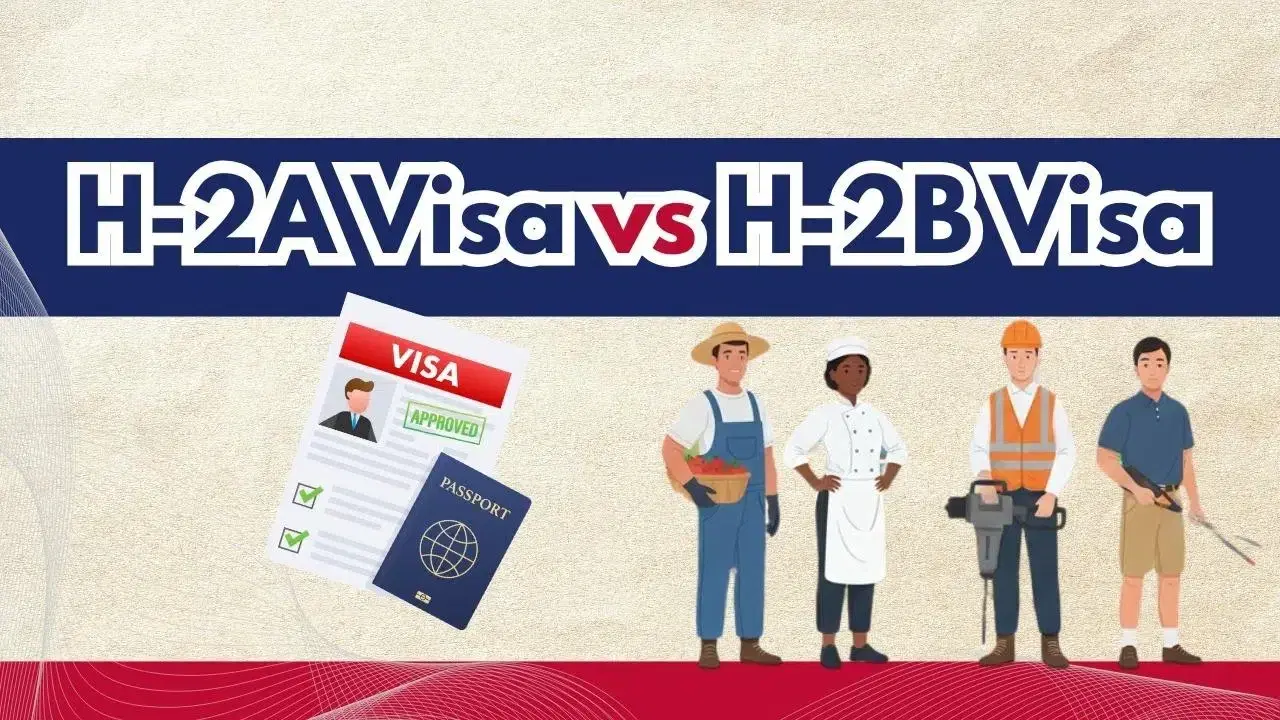
When addressing temporary labor shortages in the United States, employers often rely on specific U.S. work visa programs designed to meet seasonal and short-term workforce needs. Among the most used options for temporary foreign workers are the H-2A and H-2B visa programs.
While both visas allow U.S. employers to hire foreign nationals for temporary employment, they serve different industries and operate under distinct eligibility rules, compliance requirements, and annual limitations. This article explains the key differences between the H-2A and H-2B visas to help employers and workers determine which option best aligns with their workforce needs and employment goals.
What Is an H-2A Visa?
The H-2 visa category is divided into H-2A and H-2B classifications. The H-2A visa is designed exclusively for temporary or seasonal agricultural labor in the United States. It allows U.S. employers to hire foreign workers when qualified U.S. workers are not available to meet agricultural labor demands.
The H-2A program applies only to agricultural employment and cannot be used for non-agricultural work. Eligible jobs include farming, planting, harvesting, crop production, and livestock or animal care, provided the work is full-time and temporary or seasonal in nature.
One of the most important features of the H-2A visa is that it is not subject to an annual visa cap. Unlike many other U.S. work visas, there is no numerical limit on the number of H-2A visas issued each year, making it a flexible and reliable option for agricultural employers facing seasonal labor shortages.
What Is an H-2B Visa?
The H-2B visa is a temporary, employer-sponsored nonimmigrant visa that allows U.S. employers to hire foreign nationals to perform temporary non-agricultural work when there are not enough able, willing, qualified, and available U.S. workers.
The H-2B program is limited to jobs that are temporary in nature. An employer’s need must fall into one of four categories: seasonal need, peak-load need, intermittent need, or one-time occurrence. Common industries using the H-2B program include hospitality, landscaping, construction, amusement and recreation, restaurants, forestry, and tourism-related services.
Unlike the H-2A visa, the H-2B visa is subject to an annual numerical cap. Employers must also demonstrate that hiring H-2B workers will not negatively affect the wages and working conditions of U.S. workers employed in similar positions.
H-2A Visa Requirements:
To qualify for the H-2A program, the employer must demonstrate the following:
• The job offered is temporary or seasonal agricultural work
• There are not enough U.S. workers who are able, willing, and qualified to perform the work
• Employing H-2A workers will not adversely affect the wages or working conditions of similarly employed U.S. workers
• The employer has obtained a valid temporary labor certification from the U.S. Department of Labor (DOL)
• The approved DOL certification is submitted with the H-2A petition to U.S. Citizenship and Immigration Services (USCIS)
H-2B Visa Requirements:
The H-2B program allows U.S. employers to hire foreign workers for temporary, non-agricultural jobs when U.S. workers are unavailable.
Employee and Job Eligibility:
To qualify for the H-2B program, the employer must show that:
• There are not enough U.S. workers who are able, willing, qualified, and available for the job
• Hiring foreign workers will not negatively affect U.S. workers’ wages or working conditions
• The job is temporary, full-time, and non-agricultural
Employer’s Temporary Need Categories:
An employer’s need must fall under one of the following categories:
•One-time occurrence – a short-term, non-recurring need caused by a specific event
•Seasonal need – work tied to a predictable season or recurring annual event
• Peak-load need – temporary staff needed to supplement permanent workers during busy periods
• Intermittent need – occasional, short-term labor needs with no permanent workforce for that role
In all cases, the job must be temporary, even if the employer’s overall business is permanent.
Key Differences Between H-2A and H-2B Visas:
Feature | H-2A Visa (Temporary Agricultural Workers) | H-2B Visa (Temporary Non-Agricultural Workers) |
|---|---|---|
Visa Category | Temporary nonimmigrant worker visa | Temporary nonimmigrant worker visa |
Sector | Agricultural work only | Non-agricultural work only |
Type of Work | Farm labor or agricultural services | Temporary labor or services outside agriculture |
Nature of Job | Temporary or seasonal | Temporary (one-time, seasonal, peak-load, or intermittent) |
Examples of Jobs | Farming, harvesting, planting, livestock care | Hospitality, landscaping, construction, amusement, forestry |
Employer Requirement | Must show shortage of U.S. agricultural workers | Must show shortage of U.S. workers for non-agricultural jobs |
Labor Certification | Required from the U.S. Department of Labor | Required from the U.S. Department of Labor |
Visa Cap | No annual cap | Annual cap of 66,000 visas |
Validity Period | Based on labor certification, up to one year at a time | Based on labor certification, up to one year at a time |
Maximum Stay | Up to three years with extensions | Up to three years with extensions |
Benefits of the H-2A Visa
• Allows agricultural employers to legally hire foreign workers when domestic workers are unavailable
• No annual visa cap
• Enables lawful entry and employment for seasonal agricultural work
• Visa validity aligns with the agricultural season or certified labor period
• Extensions are available if the agricultural need continues
• Employers must provide fair wages and working conditions under DOL regulations
• Spouse and unmarried children under 21 may accompany the worker in H-4 status
• H-4 dependents may study in the United States during the authorized stay
Benefits of the H-2B Visa
• Helps employers meet short-term labor shortages for seasonal or project-based needs
• Offers flexibility through four recognized temporary need categories
• Allows foreign workers to work legally in the United States for approved periods
• Visa validity is tied to the employer’s certified labor need
• Extensions are available up to a maximum stay of three years
• Promotes compliance with Department of Labor wage and employment standards
• Spouse and unmarried children under 21 may accompany the worker in H-4 status
• H-4 dependents may study in the United States during the authorized stay
H-2A Visa Application Process
• Employer obtains a temporary labor certification from the U.S. Department of Labor
• Employer files Form I-129 with USCIS after DOL approval
• Worker applies for an H-2A visa at a U.S. consulate, if required
• Worker enters the United States to begin temporary agricultural employment
H-2B Visa Application Process
• Employer obtains a temporary labor certification from the U.S. Department of Labor
• Employer files Form I-129 with USCIS, subject to the annual H-2B cap
• Worker applies for an H-2B visa at a U.S. consulate, if required
• Worker enters the United States to perform temporary non-agricultural work
Frequently Asked Questions (FAQs)
How long can I stay in the United States on an H-2 visa?
H-2 visas are typically granted for up to one year at a time and may be extended, with a maximum total stay of three years.Can my family come with me on an H-2 visa?
Yes. Your spouse and unmarried children under 21 may accompany you in H-4 status. However, H-4 dependents are not authorized to work in the United States.Can I apply for an H-2A or H-2B visa on my own?
No. Both H-2A and H-2B visas are employer-driven. A U.S. employer must offer the job and file the petition on your behalf.How long does the H-2A or H-2B process take?
Processing times vary depending on Department of Labor certification timelines and USCIS processing. Early planning is especially important for H-2B petitions due to the annual cap.Can I change employers while on an H-2A or H-2B visa?
No. H-2 visas are employer-specific. To change employers, the new employer must file a new petition and receive approval before you can begin work.