Picture this: Two equally brilliant researchers, both with impressive publications and grants, both hoping to live permanently in the United States. One receives her green card approval in 4 months. The other waits 18 months, and still faces uncertainty.
What separates them isn’t luck. It’s choosing the right visa pathway.
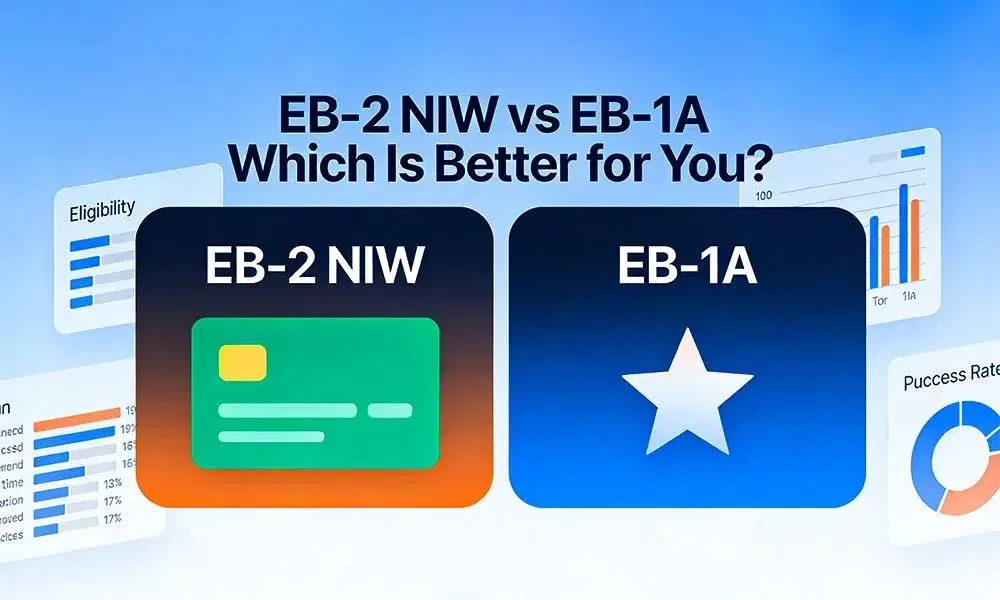
If you’re an exceptional professional eyeing a U.S. green card without employer sponsorship, you’ve likely encountered two acronyms that sound like alphabet soup: EB-2 NIW and EB-1A. Both promise freedom from labor certification and direct paths to permanent residency, yet they operate under fundamentally different frameworks.
Let’s cut through the confusion and examine what truly distinguishes these categories, who benefits from each, and which pathway aligns with your credentials in today’s immigration landscape.
Understanding EB-2 NIW: The National Interest Waiver
EB-2 NIW stands for Employment-Based Second Preference with a National Interest Waiver.
Typically, EB-2 green cards require an employer to sponsor you and prove that no qualified U.S. workers are available for your position (labor certification). The NIW waives this requirement if you can demonstrate that your work benefits the United States to such a degree that requiring employer sponsorship would be contrary to national interest.
Core Requirements:
An advanced degree (Master’s or higher) OR a bachelor’s degree plus five years of progressive work experience
Work in an area of substantial merit and national importance
Ability to demonstrate you’re well-positioned to advance your proposed endeavor
Proof that waiving the job offer requirement benefits the United States
The legal framework stems from the landmark Matter of Dhanasar (2016) decision, which established a three-pronged test that USCIS adjudicators use to evaluate NIW petitions.
Understanding EB-1A: Extraordinary Ability
EB-1A is the Employment-Based First Preference category for individuals with extraordinary ability in the sciences, arts, education, business, or athletics.
This category sets a significantly higher bar. You must demonstrate sustained national or international acclaim and provide evidence that you’ve risen to the very top of your field.
Core Requirements:
Either a one-time major internationally recognized award (Nobel Prize, Olympic Medal, etc.) OR
At least three types of evidence from a list of ten criteria, including:
Major awards or prizes
Membership in associations requiring outstanding achievement
Published material about you in major media
Service as a judge of others’ work
Original contributions of major significance
Scholarly articles you’ve authored
High salary compared to others in your field
And several others
The standard is “extraordinary ability”, you must prove you’re among the small percentage who have risen to the very top of your field.
Key Differences: EB-2 NIW vs EB-1A
Aspect | EB-2 NIW | EB-1A |
Preference Category | Second Preference (EB-2) | First Preference (EB-1) |
Educational Requirement | Advanced degree or bachelor’s + 5 years experience | No specific degree required |
Standard of Achievement | Well-positioned to advance work of national importance | Extraordinary ability; top of field |
Processing Priority | Lower priority; subject to retrogression for some countries | Highest priority; current for most countries |
Evidence Threshold | Moderate: focus on future impact and national benefit | High: sustained acclaim and past achievements |
Typical Processing Time | 12-24 months (without premium) | 8-18 months (without premium) |
Focus | Future prospective benefit to U.S. | Past accomplishments and current standing |
Difficulty Level | Moderate | High |
Visa Bulletin Impact | Significant retrogression for India, China | Generally current or minimal wait |
Benefits of Each Pathway
EB-2 NIW Benefits:
Accessibility: The bar is lower than EB-1A, making it achievable for accomplished professionals who may not yet be at the “very top” of their field.
Forward-Looking: Emphasizes your future potential and proposed work rather than requiring extensive past achievements.
Flexibility in Evidence: You can build a case around entrepreneurship, clinical work, or applied research that may not generate traditional academic metrics.
No Job Offer Required: You self-petition and maintain control of your immigration process.
Dual Intent: You can work on H-1B or other visas while your green card is pending without jeopardizing your status.
EB-1A Benefits:
Fastest Path: As a first preference category, you skip ahead of EB-2 and EB-3 applicants in the queue.
No Retrogression (for most countries): While EB-2 NIW applicants from India and China face years-long backlogs, EB-1A typically remains current.
Premium Processing: Get a decision in 15 business days for an additional fee, critical if you need certainty quickly.
No Degree Requirement: Athletes, artists, and self-taught professionals can qualify without formal education.
Prestige: Approval signifies official recognition as someone with extraordinary ability.
Faster Path to Citizenship: Earlier priority date means earlier green card, which starts the clock toward naturalization sooner.
Recent USCIS Trends (2023-2026)
Understanding current trends can significantly impact your strategy:
Increased Scrutiny Across Both Categories
USCIS has issued more Requests for Evidence (RFEs) for both EB-2 NIW and EB-1A cases. Adjudicators are demanding stronger documentation of:
Specific, detailed proposed endeavors (NIW)
Quantifiable impact and dissemination of your work
Clear evidence of recognition beyond your immediate circle
NIW Trends:
Entrepreneurship Cases Gaining Traction: USCIS has shown increasing willingness to approve NIW petitions for entrepreneurs, particularly in technology, healthcare innovation, and clean energy sectors. However, they require concrete business plans and evidence of actual progress, not just ideas.
STEM Fields Remain Strong: Scientists, engineers, and medical professionals continue to see favorable adjudications, especially when linking work to national priorities like pandemic preparedness, climate change, or technological competitiveness.
Stricter “Well-Positioned” Analysis: The second prong of Dhanasar (demonstrating you’re well-positioned to advance your endeavor) receives heightened scrutiny. Letters of recommendation, funding, preliminary results, and institutional support matter more than ever.
EB-1A Trends:
Rising Standard for “Extraordinary”: USCIS has become more stringent about what constitutes the “top of the field.” Having publications, citations, and awards may not suffice, you need to demonstrate how your work has influenced your field more broadly.
Two-Step Analysis Enforced Rigorously: USCIS first determines if you meet the initial evidence requirements, then conducts a final merits determination of whether you truly have extraordinary ability. Meeting the criteria technically isn’t enough; you must paint a compelling picture of sustained acclaim.
Judging and Review Evidence: Service as a peer reviewer for journals or grant proposals remains valuable, but USCIS now looks for evidence that you’re reviewing for prestigious publications or selective programs, not just any journal.
Processing Times Reality:
While official USCIS estimates show 6-12 months for EB-1A and 10-18 months for EB-2 NIW, real-world processing varies by service center:
Nebraska Service Center: Generally faster for both categories
Texas Service Center: More variable; can be slower but issues fewer RFEs
Premium Processing (EB-1A only): Provides certainty but doesn’t guarantee approval
Approval Chances: Who Gets What in 2026?
The right category depends on your profile. Here’s how different candidates typically fare:
Strong EB-1A Candidates:
You should seriously consider EB-1A if you:
Have received significant national or international awards
Your work is regularly cited by others (researchers with 500+ citations have strong cases)
Major media outlets have covered your work
You command a salary in the top 10% of your field
You’re regularly invited to judge others’ work in prestigious contexts
You hold a senior or critical role at a distinguished organization
You’re from India or China (avoiding EB-2 retrogression)
Recent approval patterns suggest:
Researchers with 300+ citations, 20+ publications, and regular peer review activity: ~75-85% approval rate
Tech professionals with patents, high compensation, and leadership roles: ~60-70%
Artists and athletes with national recognition: ~70-80%
Strong EB-2 NIW Candidates:
You should consider EB-2 NIW if you:
Have an advanced degree and solid (but not extraordinary) credentials
Work in an area clearly tied to U.S. national interests
Can demonstrate your work’s broader impact beyond your immediate employer
Have 5+ years of progressive experience and a clear future plan
Have some publications, presentations, or patents but may not meet EB-1A thresholds
You’re from countries without EB-2 retrogression (most countries except India, China)
Recent approval patterns suggest:
STEM professionals with advanced degrees, publications, and strong recommendation letters: ~70-80% approval
Healthcare professionals addressing underserved needs: ~75-85%
Entrepreneurs with validated business models and funding: ~50-65%
Academic researchers with moderate publication records: ~65-75%
Dual Filing Strategy:
Some applicants with borderline EB-1A credentials file both petitions simultaneously:
Advantage: Maximizes chances; if EB-1A is denied, you still have NIW pending
Disadvantage: Double the filing fees (~$1,400 total); possible USCIS skepticism if cases seem contradictory
Who does this: Primarily applicants from India and China trying to avoid retrogression, or those with urgent timeline needs
Country-Specific Considerations:
India and China-born applicants: EB-2 NIW currently faces severe retrogression (3-5+ year waits for priority dates to become current). If you qualify for EB-1A, the time savings are substantial, potentially years.
All other countries: EB-2 NIW dates are typically current or near-current, reducing the urgency of pursuing the more difficult EB-1A category.
Frequently Asked Questions
Can I switch from EB-2 NIW to EB-1A or vice versa?
Yes. These are separate petitions. You can file both simultaneously or file one and later file the other. If you have an approved EB-2 NIW with a pending adjustment of status, you can file EB-1A and, if approved, “port” your priority date to speed up your green card.
Do I need a lawyer?
While not legally required, immigration attorneys specializing in EB-1A and NIW cases significantly improve success rates. These petitions require sophisticated legal arguments and strategic presentation of evidence. Most approved petitions involve attorney assistance.
How many recommendation letters do I need?
Quality trumps quantity. Typically, 4-6 strong letters from independent experts who can speak credibly about your work’s impact are better than 10 generic letters from colleagues. For EB-1A, letters from internationally recognized figures in your field carry substantial weight.
Can I change jobs after filing?
Yes, since both are self-petitioned categories. However, for NIW, significant changes to your proposed endeavor could complicate your case. It’s advisable to inform USCIS of material changes and explain how they further your originally proposed work.
What if I get an RFE?
Requests for Evidence are common and not a denial. They indicate USCIS needs additional information or clarification. Respond thoroughly, address every concern raised, and supplement with additional evidence. RFE response quality often determines the outcome.
Can I include my spouse and children?
Yes. Your spouse and unmarried children under 21 can be included as derivative beneficiaries and receive green cards when your petition is approved and visas are available.
What happens if my EB-1A is denied but I have EB-2 NIW approved?
Each petition is evaluated independently. A denial in one category doesn’t affect the other. Many applicants maintain their EB-2 NIW as a backup while pursuing EB-1A.
How long does the entire process take from filing to green card?
This varies dramatically:
EB-1A (most countries): 1-2 years total (petition + adjustment of status)
EB-2 NIW (most countries except India/China): 1.5-3 years total
EB-2 NIW (India): 5-8+ years total due to retrogression
EB-2 NIW (China): 3-5+ years total due to retrogression
Can I apply from outside the United States?
Yes, both categories allow consular processing. However, if you’re in the U.S. on a valid visa, adjustment of status is typically faster and more straightforward.
Final Thoughts:
Both EB-2 NIW and EB-1A represent powerful pathways to U.S. permanent residency for accomplished professionals. The choice between them hinges on your credentials, timeline needs, and country of birth.
If you’re at the top of your field with strong national or international recognition, EB-1A offers the fastest route, especially critical for Indian and Chinese applicants facing retrogression. If you’re an accomplished professional with an advanced degree and important work but not yet “extraordinary” credentials, EB-2 NIW provides a realistic path forward.
The key to success in either category? Start with honest self-assessment, gather compelling evidence of your achievements and impact, and present your case strategically. In immigration, as in your professional life, preparation and precision make all the difference.
Official Resources for Further Information
EB-1A Information:
USCIS EB-1 Petition Page: https://www.uscis.gov/working-in-the-united-states/permanent-workers/employment-based-immigration-first-preference-eb-1
EB-2 NIW Information:
USCIS EB-2 Petition Page: https://www.uscis.gov/working-in-the-united-states/permanent-workers/employment-based-immigration-second-preference-eb-2
Matter of Dhanasar Decision: https://www.justice.gov/eoir/page/file/920996/dl
Policy Manuals:
USCIS Policy Manual, Volume 6 (Immigration Benefits): https://www.uscis.gov/policy-manual/volume-6
Processing Times:
Check current processing times by form and service center: https://egov.uscis.gov/processing-times/
Visa Bulletin:
Monthly Visa Bulletin (for priority date tracking): https://travel.state.gov/content/travel/en/legal/visa-law0/visa-bulletin.html
Department of State Resources:
Consular Processing:
Immigrant Visa Process: https://travel.state.gov/content/travel/en/us-visas/immigrate/the-immigrant-visa-process.html
Forms and Filing:
Key Forms:
Form I-140 (Immigrant Petition for Alien Worker): https://www.uscis.gov/i-140
Form I-485 (Adjustment of Status): https://www.uscis.gov/i-485
Form I-907 (Premium Processing): https://www.uscis.gov/i-907
Legal Decisions and Precedents:
Important Case Law:
Matter of Dhanasar, 26 I&N Dec. 884 (AAO 2016) – Established current NIW framework
Kazarian v. USCIS, 596 F.3d 1115 (9th Cir. 2010) – Established two-step analysis for EB-1A
Community and Support:
While not official government resources, these forums provide peer insights (verify information independently):
USCIS Case Tracker (community-driven processing time data)
Immigration forums like VisaJourney or Trackitt